
Traditional forecasting methods often assume static relationships, linear outcomes, and predictable conditions.
Revenue System Dynamics™ applies advanced systems modeling, optimization frameworks, scenario analysis, and probability-based evaluation to help organizations better understand:
The objective is not simply forecasting. The objective is improving strategic decision quality.
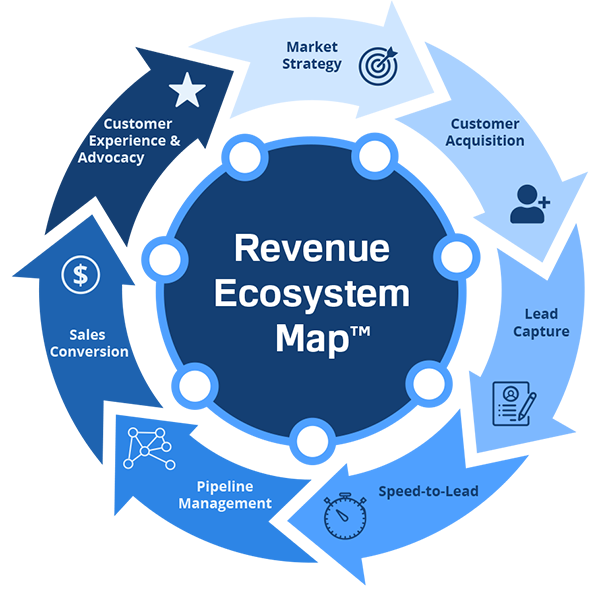
Revenue System Dynamics™ evaluates how interconnected operational variables influence performance across the broader revenue ecosystem.
We build a systems-based model of your organization that incorporates:
This model is then used to evaluate possible future outcomes, operational tradeoffs, areas of leverage, and strategic scenarios under varying conditions.
The objective is not producing a single forecast. The objective is understanding probability, uncertainty, and strategic leverage across the ecosystem.
Static Assumptions – Many forecasting models assume stable relationships even as operational conditions evolve. | Limited System Interaction – Traditional planning methods often fail to account for how one stage of the ecosystem influences another. |
Timing & Delays – Operational improvements, hiring, onboarding, and process changes often influence performance over time rather than immediately. | Uncertainty – Leadership decisions are rarely made under perfectly predictable conditions. |
Tradeoffs & Constraints – Organizations must constantly evaluate competing priorities, limited resources, and operational dependencies. | Hidden Leverage Points – Small improvements in the right area of the ecosystem can sometimes create disproportionately large downstream impact. |
Revenue System Dynamics™ follows a structured modeling process designed to evaluate strategic possibilities, operational tradeoffs, and ecosystem behavior under varying conditions.
Step | Description | Typical Duration |
1. Map the Revenue Ecosystem | We identify key operational variables, dependencies, feedback relationships, constraints, and strategic decision factors through stakeholder interviews, data review, and process analysis. | 1‑2 weeks |
2. Calibrate the Model | We evaluate available operational, financial, pipeline, and ecosystem data to calibrate the model using realistic assumptions. Revenue Pipeline Diagnostic™ findings may also be incorporated. | 2‑3 weeks |
3. Evaluate Strategic Scenarios | We evaluate multiple strategic scenarios to identify probability ranges, operational tradeoffs, leverage opportunities, and resource allocation priorities. | 1‑2 weeks |
Note: Timelines vary based on organizational complexity, data availability, and scope of decisions being modeled.
Scenario Analysis – Evaluate potential future outcomes under varying operational conditions and strategic assumptions. | Sensitivity & Leverage Analysis – Identify which variables create the greatest influence across the broader ecosystem. |
Resource Allocation Modeling – Evaluate how budget, staffing, operational capacity, and investment decisions may influence ecosystem performance. | Probability & Outcome Ranges – Evaluate likely ranges of future performance under uncertainty rather than relying on single-number forecasts. |
Growth Constraint Analysis – Identify operational bottlenecks, capacity limitations, and ecosystem dependencies influencing scalability. | Executive Strategy Workshops – Where appropriate, collaborative strategy sessions may be conducted using the modeled ecosystem. |
Strategic Tradeoff Evaluation – Compare competing strategic paths and evaluate their potential downstream impact. | Optimization Recommendations – Identify operational areas where focused improvements may create disproportionately large performance impact. |
A growing service organization was evaluating multiple strategic options, including:
Rather than relying on isolated assumptions, Revenue System Dynamics™ was used to evaluate how these variables interacted across the broader revenue ecosystem under multiple possible future conditions.
The modeling process revealed that operational conversion improvements produced significantly greater projected long-term impact than increasing acquisition spend alone.
This allowed leadership to prioritize operational optimization before scaling acquisition investment.
Better strategic decisions often create greater long-term impact than simply increasing activity.
Revenue System Dynamics™ engagements vary depending on organizational size, ecosystem complexity, modeling scope, operational variability, leadership involvement, strategic objectives, available data environments, and scenario requirements.
Some engagements focus on a single operational decision or strategic question. Others evaluate broader ecosystem-wide optimization and long-term strategic planning.
Engagement Type | Typical Focus | Typical Duration |
Focused Modeling Engagement | Specific operational decision or departmental analysis | 2‑3 weeks |
Multi‑Stage Ecosystem Modeling | Cross-functional operational and ecosystem analysis | 4‑6 weeks |
Enterprise Strategic Dynamics | Broad strategic planning and ecosystem optimization | 8‑12 weeks |
Note: Scope, timelines, and investment structures vary depending on organizational complexity and modeling requirements.
Revenue System Dynamics™ is typically used after a Revenue Pipeline Diagnostic™ or Revenue System Remediation™. Its purpose is not simply identifying operational friction. Its purpose is evaluating optimization opportunities, strategic tradeoffs, future scenarios, operational leverage, resource allocation decisions, and ecosystem behavior under uncertainty.
Need to fix operational friction first? Revenue System Remediation™ may be the right next step.
Strategic Clarity – Evaluate complex decisions using structured systems analysis rather than isolated assumptions. | Probability Awareness – Understand possible outcome ranges under uncertainty rather than relying on static forecasts. |
Tradeoff Visibility – Compare competing strategic paths and understand potential downstream implications. | Resource Allocation Confidence – Make more informed decisions about staffing, investment, operational focus, and growth priorities. |
Leverage Identification – Identify which variables create the greatest influence across the ecosystem. | Ecosystem Perspective – Evaluate how operational decisions influence interconnected stages of the broader revenue system. |
If your organization is facing complex operational, growth, or resource allocation decisions and requires more sophisticated strategic visibility than traditional forecasting methods provide, Revenue System Dynamics™ may help improve strategic decision-making under uncertainty.

Revenue Systems Consulting Group helps businesses improve the systems that drive revenue growth.